• Welcome to your new Gnomio site

    Now, you are in control!

    Moodle is an open-source Learning Management System (LMS) that provides educators with the tools and features to create and manage online courses. It allows educators to organize course materials, create quizzes and assignments, host discussion forums, and track student progress. Moodle is highly flexible and can be customized to meet the specific needs of different institutions and learning environments.

    Moodle supports both synchronous and asynchronous learning environments, enabling educators to host live webinars, video conferences, and chat sessions, as well as providing a variety of tools that support self-paced learning, including videos, interactive quizzes, and discussion forums. The platform also integrates with other tools and systems, such as Google Apps and plagiarism detection software, to provide a seamless learning experience.

    Moodle is widely used in educational institutions, including universities, K-12 schools, and corporate training programs. It is well-suited to online and blended learning environments and distance education programs. Additionally, Moodle's accessibility features make it a popular choice for learners with disabilities, ensuring that courses are inclusive and accessible to all learners.

    The Moodle community is an active group of users, developers, and educators who contribute to the platform's development and improvement. The community provides support, resources, and documentation for users, as well as a forum for sharing ideas and best practices. Moodle releases regular updates and improvements, ensuring that the platform remains up-to-date with the latest technologies and best practices.

    Links of interest:

    (You can edit or remove this text)

Available courses

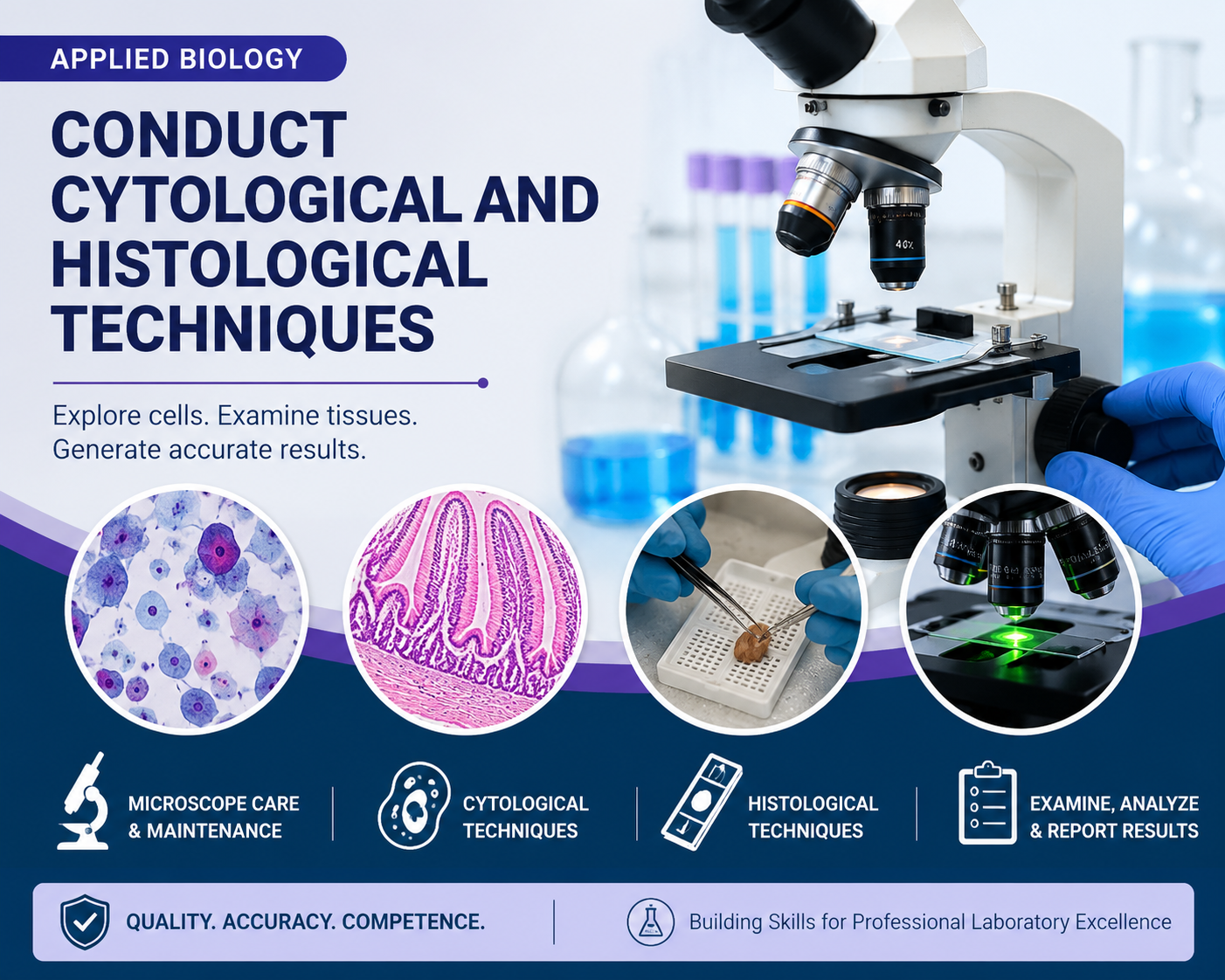
This course equips learners with the knowledge, practical skills, and competencies required to conduct cytological and histological techniques in applied biology laboratories. The course focuses on the principles and procedures involved in microscope care and maintenance, cytological specimen preparation and examination, and histological specimen processing and analysis. Learners will gain hands-on experience in handling laboratory equipment, preparing specimens, observing cellular and tissue structures, interpreting results, and reporting findings according to established laboratory procedures and standards.

The course also develops competencies in microscope operation, cell structure identification, specimen collection and processing, laboratory safety, and accurate reporting of laboratory outcomes. Through practical activities, projects, assessments, and portfolio development, learners will acquire the skills necessary to perform cytological and histological procedures in professional laboratory settings.

Learning Outcomes
By the end of this course, learners should be able to:

  1. Carry out care and maintenance of microscopes.
  2. Perform cytological techniques.
  3. Perform histological techniques.

Course Duration: 120 Hours

This course combines theoretical concepts with practical laboratory experiences to prepare learners for competency-based performance in biological and medical laboratory environments.

This course introduces learners to the principles of Applied Biology and Biochemistry with emphasis on competence-based training. It covers fundamental biological concepts, biochemical processes, laboratory techniques, and safety practices relevant to TVET and applied science environments. The course integrates theory, practical activities, and assessments to support skill development for laboratory, industrial, and research contexts.